

Times are tough for rural businesses.
As wholesale prices often fail to cover the cost of production, more farms are looking for ways to generate additional income.
According to Defra, over 72% of UK farms have already diversified in some way, increasing competition.
However, as consumers tighten their belts across the country, can we expect customers for new business?
You’ve If you are diversifying your land, you may already considered farm diversification ideas like:
- SFI schemes
- Woodland or agroforestry (you can read more about woodland creation through The Woodland Trust)
- Glamping
- Holiday cottages
- Workshops
- Farm experiences
- Educational visits
- A farm shop
- Selling direct to customers
You don’t need more ideas. You need to know which one is actually worth your time, money and energy.
A Little More Outdoor is all about businesses that give you the freedom to live life in the environments you love.
Having run everything from outdoor centres and farms to purely online businesses, this article helps you
- Avoid mistakes we made,
- Identify the right business for you
- Develop a strategy to make it real
Then farm diversification ideas are likely top of your agenda.
Take the OPS challenge
Why Most Farm Diversification Fails
Why Most Farm Diversification Fails
Every diversification opportunity sounds promising.
- The one with the biggest projected returns.
- The one another farm is already doing successfully.
- The one a consultant, supplier or industry expert tells you is the next big thing.
And when margins are tight or the farm needs another income stream, it’s easy to believe the answer is simply adding another enterprise.
- “Let’s build glamping.”
- “What about holiday cottages?”
- “We could open a farm shop.”
- “Maybe educational visits or farm experiences.”
Then another idea comes along.
And another.
Before long, you’re not running one strong business. You’re trying to manage five or six different ones, each demanding
- marketing,
- maintainance
- administration,
- customer service,
- investment and your time.
Diversification isn’t the problem.
Unvalidated diversification is.
We’ve made this mistake ourselves.
We believed more opportunities would create more security.
Instead, they created more complexity, more pressure and a business that became harder to manage.
The truth is, every farm is different.
Most of us didn’t choose this life because it offered the highest financial return. We chose it because we love the land, the lifestyle and the legacy we’re building.
That means the right diversification isn’t necessarily the one with the highest earning potential. It’s the one that fits your land, your skills, your resources, your family and the future you’re trying to create.
The rural businesses that build sustainable income rarely succeed because they do everything. They succeed because they identify one valuable opportunity, prove people actually want it, and build it properly before expanding.
That’s exactly what this guide will help you do.
Build the right business first, before investing significant time, money and energy into the wrong one.
The 7 Mistakes That Cost Rural Businesses Time and Money
1. Starting with the idea instead of the customer
A successful diversification project doesn’t begin with:
“What could we build?”
It begins with:
“What are people asking for?”
The best ideas solve real problems for real customers.
Action:
Before investing in buildings, equipment or infrastructure,
understand who you want to serve and why they would choose your offer.
2. Assuming more income streams reduce risk
It feels logical.
If one enterprise struggles, another will compensate.
But multiple unproven businesses often multiply costs, complexity and stress before they multiply income.
Action:
The goal isn’t to create more things to manage.
The goal is to create reliable income by identifying something customers genuinely value.
3. Investing before validating demand
- Planning permission.
- Buildings.
- Equipment.
- Websites.
- Marketing.
These might be necessary later, but they don’t prove customers will buy.
Validation comes first.
Investment comes second.
Action:
A simple test with real customers can often teach you more than months of planning.
4. Copying what another farm is doing
Someone else’s success can be inspiring.
But their:
- Location
- Audience
- Resources
- Experience
- Lifestyle goals
are different from yours.
The best diversification idea isn’t the one that worked somewhere else.
Action:
Test what actually works for you and your land.
5. Confusing activity with progress
Being busy feels productive.
But busy doesn’t always mean you’re building something profitable.
Many businesses spend months creating offers nobody has asked for.
Action:
Talk to potential customers early can save huge amounts of time and money.
6. Ignoring the lifestyle you’re trying to protect
Most people choose rural business because they want a better way of life.
Not because they want to create five more jobs for themselves.
Every new enterprise should move you closer to the lifestyle you want, not further away from it.
Action:
Think about what you want to spend your days doing.
7. Trying to scale by adding more offers
Growth rarely comes from constantly adding something new.
It usually comes from improving one offer, reaching more of the right people and delivering it consistently.
Build one thing that works before building five things that compete for your attention.
Action:
Learn basic marketing skills (it’s not what you think) more on this later.
What Makes a Good Farm Diversification Idea?
The best diversification ideas usually have four things in common.
They:
✅ Solve a genuine problem people are willing to pay for.
✅ Fit your land, skills, resources and long-term goals.
✅ Can be tested before significant investment.
✅ Can be delivered consistently without taking over your life.
- That might be accommodation.
- It might be experiences.
- It might be education.
- It might be products.
The answer is different for every farm.
The important thing is finding the opportunity where your assets and customer demand overlap.
The Mistake We Made: Trying to Build Too Much

Years ago, we believed saying yes to every opportunity was how businesses grew.
We had a small hill farm where we ran an outdoor centre and an agriculture training centre.
Every new activity felt like another chance to improve the numbers.
- Canoeing.
- Camping.
- Cooking.
- Residentials.
- Archery.
- Obstacle courses.
- Farm activities.
- Apprenticeships
- Pig to plate experiences.
- Vegetables.
- Chickens.
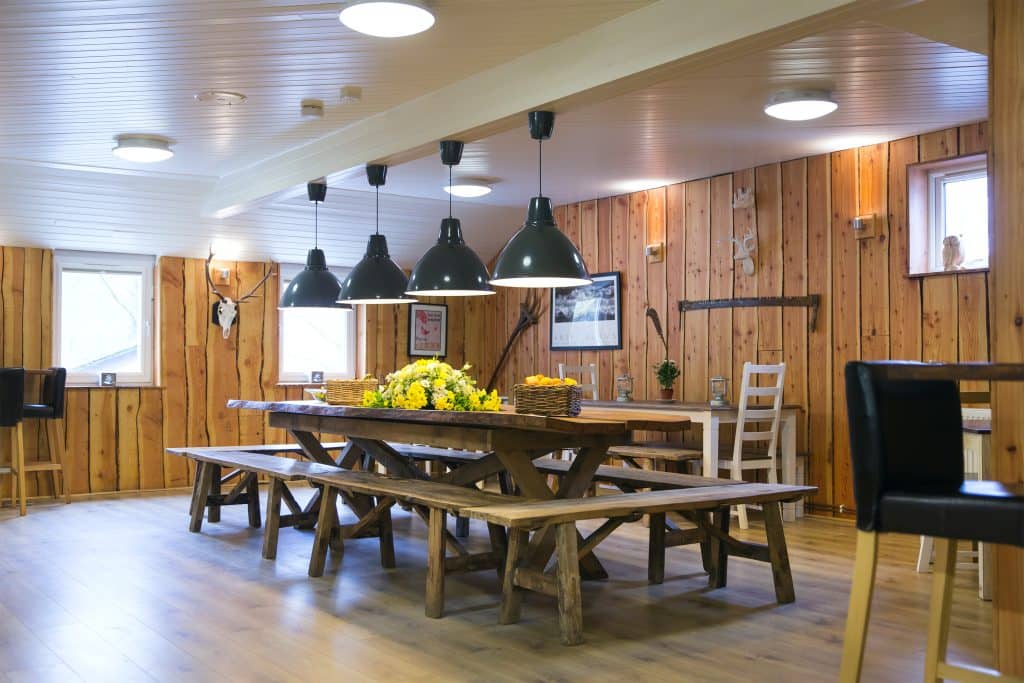
We worked with schools, youth groups, corporate groups, weddings, community groups and many others.
On paper, it looked like growth.
In reality, every new offer created more complexity.
More equipment.
More marketing.
More administration.
More things needing attention.
We worked harder than ever, but the margins became thinner and thinner.
Eventually, we lost the business and had to start again.
Looking back, we didn’t need more opportunities.
We needed one clear offer that customers truly wanted, validated before we invested, and built well enough to grow.
That lesson completely changed how we think about diversification.
The Dirty Word: Marketing
Let’s talk about the word that makes many rural business owners uncomfortable.
Marketing.
For many of us, marketing feels like becoming someone we’re not.
Posting constantly on social media. Chasing attention. Trying to convince people why we’re worth choosing.
That’s not why most of us chose rural life.
We wanted to work with the land, create something meaningful and focus on doing a good job.
The good news is that effective marketing isn’t about shouting louder.
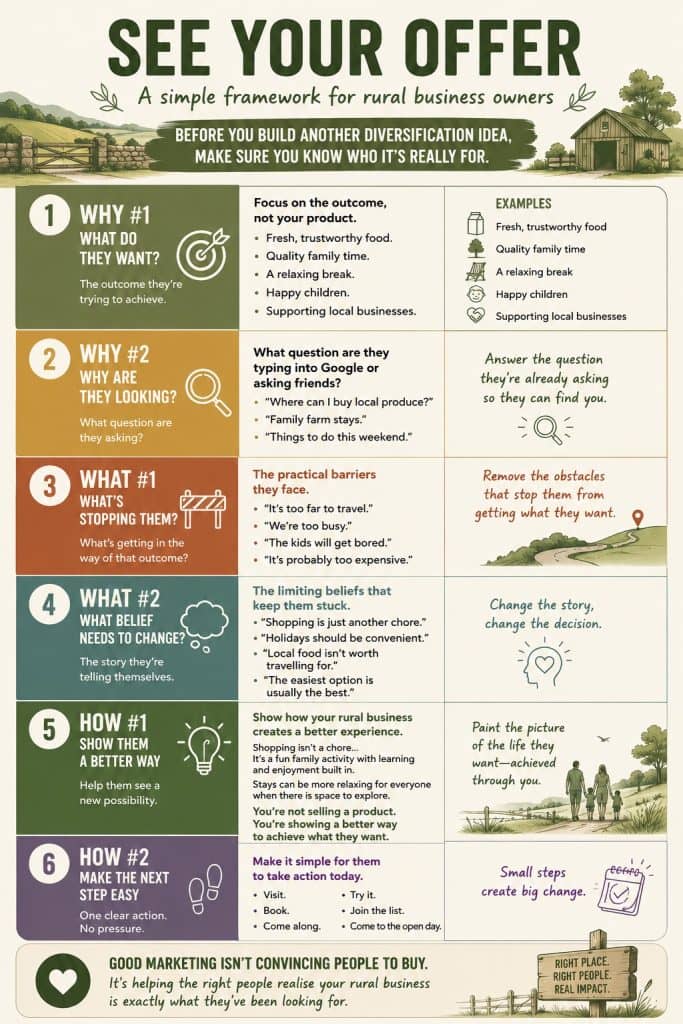
It’s about being clear on the problem you solve and making it easy for the right people to find you.
You don’t need to become an influencer.
You need an offer that matters to the right customer.
The Other Dirty Word: Customers
The second word that makes many rural businesses hesitate is…
Customers.
Selling direct can feel like trading farming for customer service.
More emails.
More questions.
More explaining.
More trying to convince people why your product or experience is worth paying for.
It’s understandable why many farms continue selling through traditional channels, even when margins are tight.
But the best direct-to-customer businesses don’t spend their time chasing people.
They create something valuable for a specific customer and become the obvious choice when that customer is ready to buy.
The goal isn’t to convince everyone.
It’s to attract the people who are already looking for what you offer.
That’s exactly what we help you do in the free 4-Week OPS Challenge: identify a valuable problem, create the right offer, and test demand before investing heavily.
Build the right offer first.
→ Start the Free 4-Week OPS Challenge
Build One Offer Before Building Five
The most successful rural businesses aren’t always the ones with the most enterprises.
They’re often the ones with the clearest offer.
If you’re thinking about diversifying your farm, don’t start by asking:
“What else could we do?”
Start by asking:
“What are people actually asking for?”
“How can we deliver it, our way?“
“What land, skills, experience and resources can we use?“
Then test it.
Speak to customers.
Create a simple version.
Learn what works.
Only invest further when you have evidence.
Because the goal isn’t simply to diversify.
The goal is to build a business that creates financial breathing room while supporting the life you actually want to live.
Ready to Build the Right Business First?
The free 4-Week OPS Challenge helps you identify opportunities, validate ideas and build an offer before investing heavily.
In just 20 minutes a day, you’ll learn how to find the right problem, create a solution people want, and take practical steps towards building a more flexible rural business.
Start the Free 4-Week OPS Challenge
Build one offer that’s worth growing instead of five that compete for your time.